
↓
 

chart planet

data-human interaction

chart planet

data-human interaction

  • blog
    • dashboard design
    • data visualisation
    • Power BI asteroid
    • reviews
  • visuals
    • charts
    • interfaces
  • LT
    • grafikai
    • apie duomenų vizualizaciją
  • inspirations
  • talks
  • about

Tag Archives: Wages

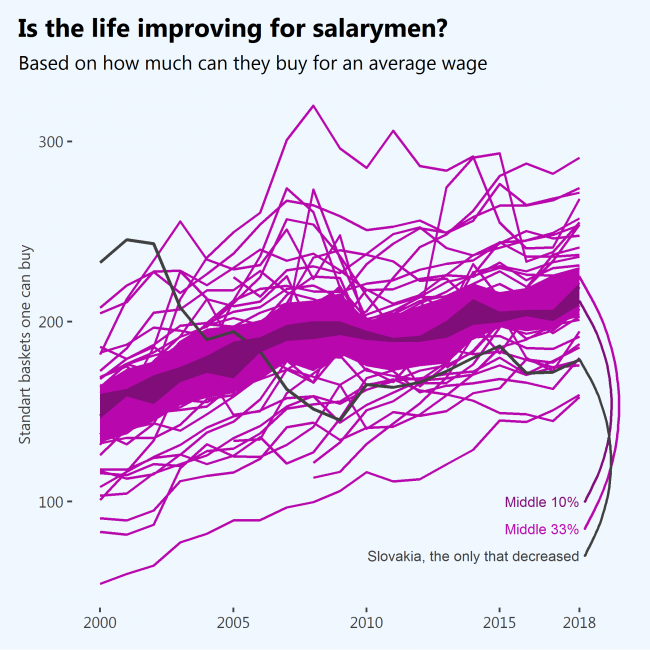
Is the life improving for salarymen?

chart planet Posted on 2020-05-13 by Chart Planet2023-03-18
Is the life improving for salarymen?

Based on how many average baskets of goods one can buy for an average salary while living alone and without children – yes, absolutely. There were wiggles after the crisis, but the overall trend is upwards – people can buy more and more stuff because salaries are increasing faster than prices.
The only sad exception in the period analyzed is Slovakia.

What: Annual net earnings divided by price level index which result in the number of standard baskets of goods one can buy.
The average wage is “annual net earnings of a full-time single worker without children earning an average wage” measured in Purchase Power Standards.
Price level index is made to be 100 in 2020 for the EU as a whole for a standardized basket of goods. It is tailored for cross-country comparison.
Data for OECD countries was estimated using “Price level ratio of PPP conversion factor (GDP) to market exchange rate” (provided by WB, very accurate estimates), and “Average annual wage in 2018 constant prices at 2018 USD PPPs” (provided by OECD, not very accurate estimates)
When: 2000 – 2018
Where: 39 countries from the EU and OECD.
Source: EUROSTAT, OECD, WB

Posted in charts | Tagged R, Spaghetti chart, Wages

Where do salarymen have the best life?

chart planet Posted on 2020-05-11 by Chart Planet2023-03-18

Based on how many average baskets of goods one can buy for an average salary while living alone and without children – Poland takes the lead followed by Germany. For some time the United States seemed the best country for that. However in a few decades, things can change drastically – the Slovak Republic once at the top, now is somewhere at the bottom, and Poland itself climbed a long way up – the time between 2009 and 2010 was a mess.

It is very difficult to find time-series data about the average salary, so only the EU and OECD countries are included in this chart. It would be interesting to see how cheap is Thailand for Thai people!

What: Average wage divided by price level index which results in the number of standard baskets of goods one can buy.
The average wage is “annual net earnings of a full-time single worker without children earning an average wage” measured in Purchase Power Standards.
The price level index is made to be 100 in 2020 for the EU as a whole for a standardized basket of goods. It is tailored for cross-country comparison.
Data for OECD countries was estimated using “Price level ratio of PPP conversion factor (GDP) to market exchange rate” (provided by WB, very accurate estimates), and “Average annual wage in 2018 constant prices at 2018 USD PPPs” (provided by OECD, not very accurate estimates)
When: 2000 – 2018
Where: 39 countries of the world
Source: EUROSTAT, OECD, WB

Posted in charts | Tagged Bump chart, Interactive, R, Wages

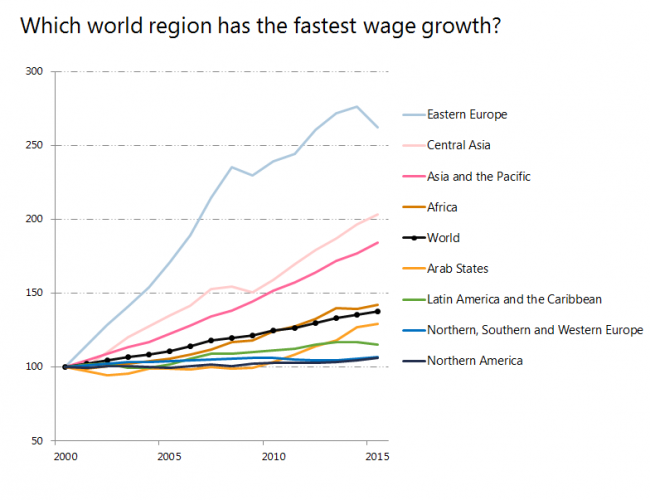
Which world region has the fastest wage growth?

chart planet Posted on 2018-11-14 by Chart Planet2023-03-18
Which world region has the fastest wage growth?

In Eastern Europe, they’ve risen a lot since 2000, but recently Asia and the Arab States are doing better.

What: mean real monthly earnings of employees, rebased index
When: 2000 – 2015 (well, data is old, but still gives an insight)
Where: World regions according to ILO
Source: ILO

Posted in charts | Tagged Excel, Line chart, Wages

subscribe to blog posts

Please check your email to confirm subscription

linkedin fb bluesky instagram tableau sessionize rss
MJDC privacy policy
↑
Cookies are used on chart planet.