↓
 

chart planet

data-human interaction

chart planet

data-human interaction

  • blog
    • dashboard design
    • data visualisation
    • Power BI asteroid
    • reviews
  • visuals
    • charts
    • interfaces
  • LT
    • grafikai
    • apie duomenų vizualizaciją
  • inspirations
  • talks
  • about

Tag Archives: Boxplot

Is discipline helping to be more productive?

chart planet Posted on 2020-08-03 by Chart Planet2023-03-18
Is discipline helping to be more productive?

This is another data selfie based on my own observation of myself.

I tracked down how disciplined am I based on how well I stick to my daily routine and also how much of weekly goals I do achieve. There is a visible positive correlation, but two facts leave me unconvinced that discipline is really useful: 1. When I am the least disciplined, my results are not really bad, at some weeks I even managed to achieve 100% 2. When I am the most disciplined, at some weeks I had results that are among the worst.

I guess that when I concentrate too much on those “daily routine” and “discipline” things I might be more motivated, but then I have less time for actual work on my goals. After those weeks of tracking my results, I dropped the effort to stick to the daily routine completely. And I believe I am as productive as I can be.

What: The proportion of weekly goals achieved and “level of discipline” measured in points. Discipline points are binned into arbitrary intervals, and the white gradient shows median at its brightest point.
When: 38 weeks during 2019-2020
Source: self-observation

My real goal here was to draw really “creative” chart even if it is hard to read.
Posted in charts | Tagged Boxplot, Data selfie, R

Is the EU more homogenous or diverse?

chart planet Posted on 2020-04-15 by Chart Planet2023-03-18
Is the EU more homogenous or diverse?

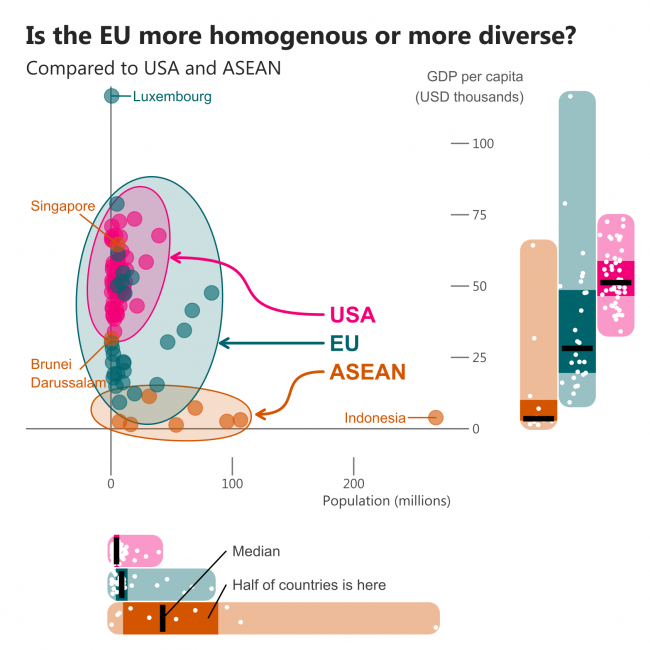
I believe you’ve heard about “Europe of two speeds”. But to understand whether those two speeds are really different we need to compare it to something. I picked two options – one is ASEAN, an organisation in Southeast Asia that promotes integration in economic, political and other fields. Another one is the USA and its states.

I’m comparing two core measures – GDP per capita and population.
Boxplots at the bottom and the right side of the chart show us that the USA is a highly homogenous entity compared to the other two.
If we look at population only, there seems to be a lot of variety in ASEAN, however, there are only 10 countries with one clear outlier – Indonesia. This country is not encircled in the scatterplot, and the encircling ellipses of the EU and ASEAN have quite similar widths. EU just has way more small countries.

Checking the GDP per capita gives a clear view of the diversity of the EU. If the two richest ASEAN countries are excluded, it becomes very homogenous – all the other countries are on the poor side.

Conclusion: EU is diverse even compared to Asian standards.

What: Population and GDP per capita in current USD (for ASEAN and EU) and GDP per capita in chained 2012 USD (for the USA). I believe this inconsistency is of minor influence since the diversity inside the group is what matters – comparisons of states and countries should not be made.
When: 2018, except Population of the USA which is an estimate for 2019
Where: Countries of EU and ASEAN as well as states of the USA.
Source: WB + BEA and USCB for USA states

Posted in charts | Tagged Boxplot, Geopolitics, R, Scatterplot

Is economic freedom needed for economic prosperity?

chart planet Posted on 2019-12-30 by Chart Planet2023-03-18
Is economic freedom needed for economic prosperity?

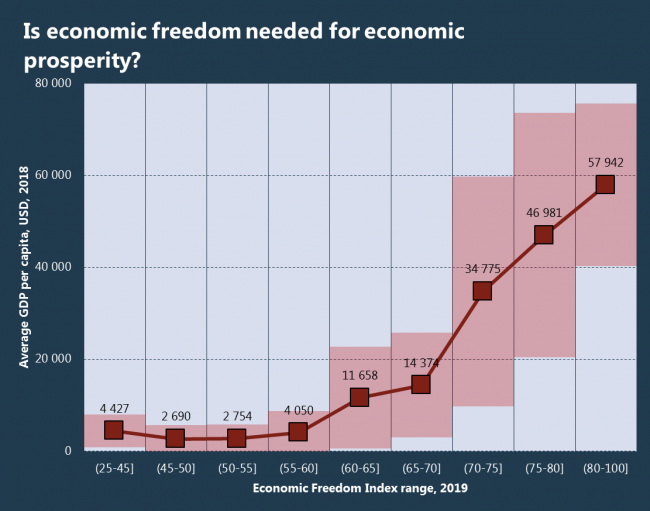
Pardon me for asking the obvious. But if less democratic countries manage to maintain high levels of HDI, maybe less economically free countries manage to reach high levels of GDP per capita? The answer is no, the relationship is clear and exponential – free economy is best. That might surprise, but even the United Arab Emirates are economically free, they rank the 9th in the world by economic freedom.

What: Average GDP per capita in USD in a given Economic Freedom Index range. The red area represents the standard deviation – with higher Index values, the GDP becomes more volatile.
When: I’d say the whole graph is 2018 because Economic Freedom Index represents previous years.
Where: 175 countries of the world.
Source: The Heritage Foundation and WB

Posted in charts | Tagged Boxplot, Excel, GDP

subscribe to blog posts

Please check your email to confirm subscription

linkedin fb bluesky instagram tableau sessionize rss
MJDC privacy policy
↑
Cookies are used on chart planet.