↓
 

chart planet

data-human interaction

chart planet

data-human interaction

  • blog
    • dashboard design
    • data visualisation
    • Power BI asteroid
    • reviews
  • visuals
    • charts
    • interfaces
  • LT
    • grafikai
    • apie duomenų vizualizaciją
  • inspirations
  • talks
  • about

Category Archives: visuals

graphic insights about the world we live in

Post navigation

<< 1 2 3 4 5 6 7 8 9 >>

Are there more livestock, pets, wild animals or humans?

chart planet Posted on 2020-05-04 by Chart Planet2023-03-18
Are there more livestock, pets, wild animals or humans?

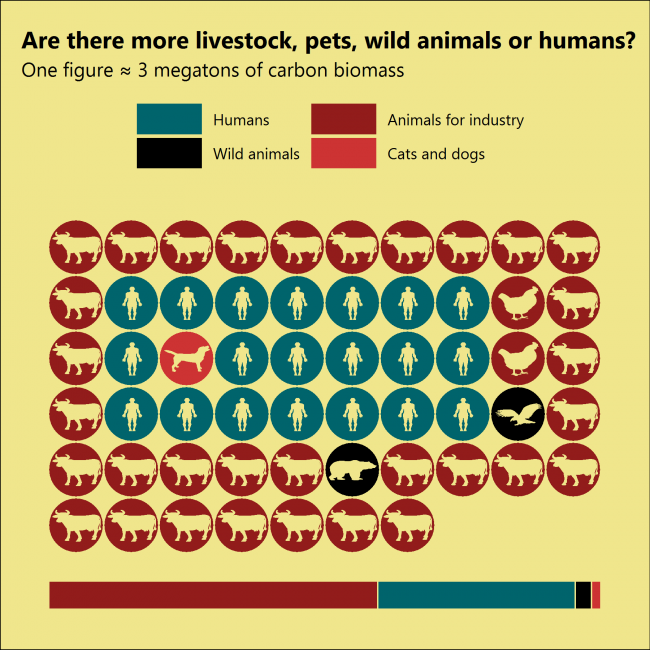
Livestock. All this data is very unreliable, especially for animals living in the wild, but some rough estimates were made, and we know that there are probably 30 times more mammals kept as livestock than wild land mammals, and 2 times more birds kept as livestock than wild birds. Also, there are as many cats and dogs as animals in the wild.

These “quantities” are actually a total mass of carbon, which according to the Source make roughly 15% of total body mass. So, there might be lots of chicken, but they don’t weight as much as cows. The same with little wild animals – there might be more rats than cows.

Also, some types of animals were not taken into account, for example, reptiles, arthropods, sea mammals. I decided to concentrate on mammals and birds living above the ground. I’d include reptiles, but there are no reliable estimations about them.

What: Mass of carbon inside mammals and birds.
When: Data were taken from a study published in 2018, which used data from FAO. So, I guess it’s not very old.
Where: Land and above.
Source: Bar-On, Yinon M et al. “The biomass distribution on Earth.” Proceedings of the National Academy of Sciences of the United States of America vol. 115,25 (2018).
Also, https://www.worldatlas.com used to estimate the mass of cats and dogs which were not included in the paper above.

Posted in charts | Tagged Nature, R, Unit chart

Is it a good idea to invest when stocks go down?

chart planet Posted on 2020-04-29 by Chart Planet2023-03-18
Is it a good idea to invest when stocks go down?

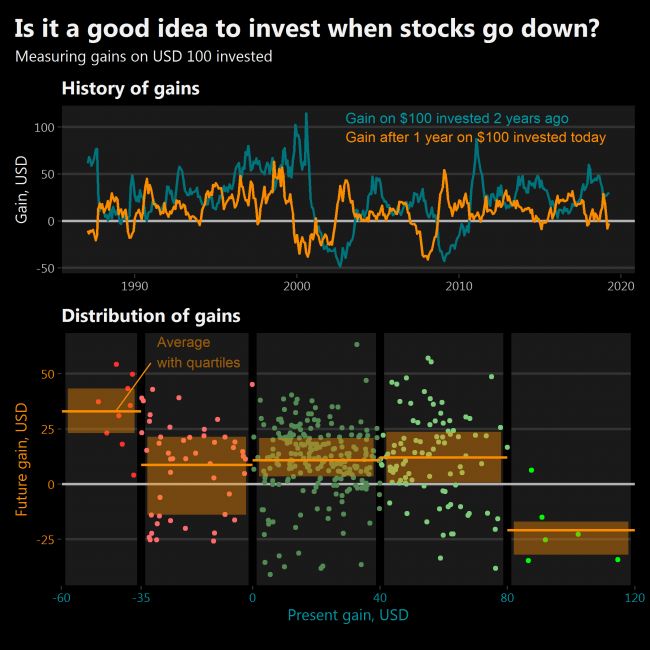
Yes, but only if the market has crashed very seriously. The same is with selling – historically it is good to sell only when markets have skyrocketed unprecedently.

Suppose I have invested USD 100 in stock two years ago. It has gained some positive or negative amount of dollars since then. What gains could I expect after one year if I invest USD 100 today? After analyzing historical data I see that future gains are almost certainly positive only when markets have had dropped more than 35% in two years from their original value. Also, future gains are almost certainly negative when markets have had grown more than 80% from their original value.

What: “Gain” is the amount in dollars one’s investment would change from the initial USD 100 invested. Investment is divided equally between Dow Jones Industrial Average and Nasdaq Composite indices.
When: Monthly data between February 1985 and April 2020
Source: investing.com

Posted in charts | Tagged Investing, Line chart, R, Scatterplot

Are gold and oil safe-haven investments?

chart planet Posted on 2020-04-27 by Chart Planet2023-03-18
Are gold and oil safe-haven investments?

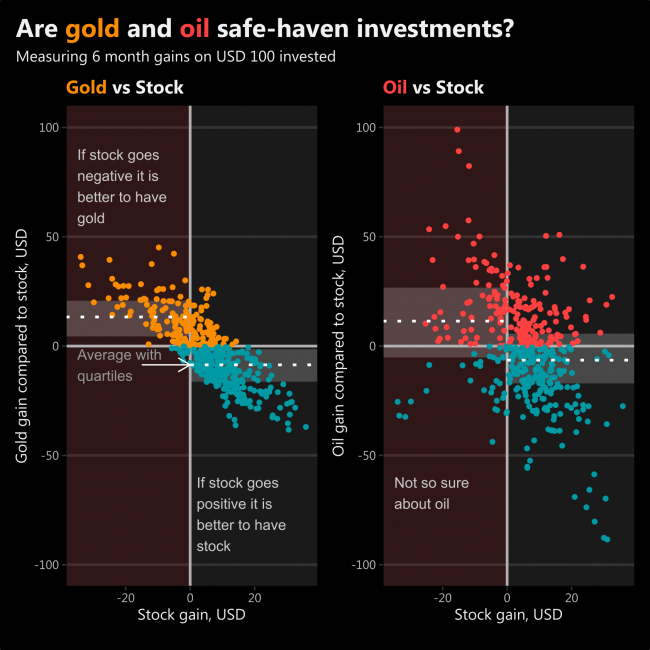
One dot represents one moment in time between February 1985 and April 2020. So, if you sense, that after 6 months the price of stocks will be lower than today, it might be a good idea to start buying gold. Based on historical data, it will probably end up gaining you positive returns.
Whereas oil gains are not that consistent.

This tiny analysis of scatterplots shows that gold is a safe-haven investment and oil is not so.

What: “Gain” is the amount one’s investment would change if USD 100 were invested six months ago. Stock is made from Dow Jones Industrial Average and Nasdaq Composite indices. Oil is represented by Crude Oil.
When: Monthly data between February 1985 and April 2020
Source: investing.com

Posted in charts | Tagged Investing, Post-design, R, Scatterplot

Are gold and oil good investments?

chart planet Posted on 2020-04-22 by Chart Planet2023-03-18
Are gold and oil good investments?

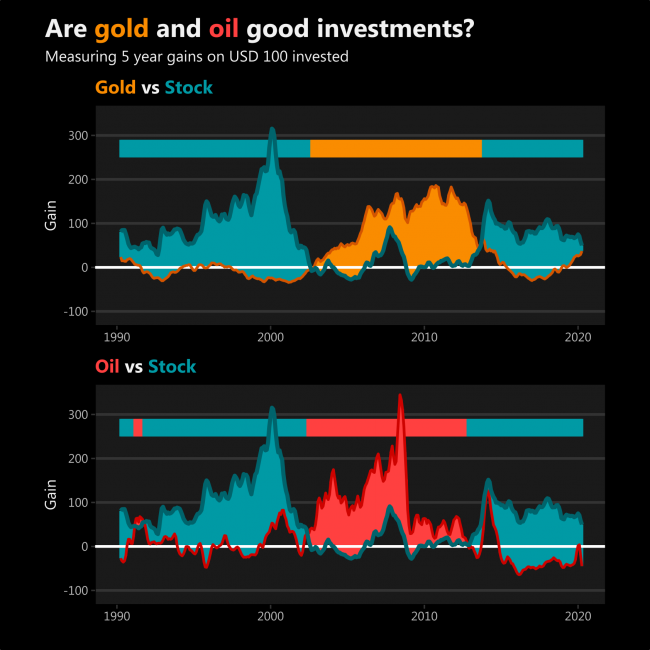
I never really understood investing in commodities. It seems that gold and oil gain more for long term investors when stock prices begin to go down and other investors seek alternative investments, thus raising the price of oil and gold.

After such interpretation, it seems that a recent increase in gold gain is probably caused by investors running from stock markets which are about to collapse, not anything related to gold itself. This might not be true.

However, oil gains have some significant fluctuations on their own.

What: “Gain” is the amount one’s investment would change if USD 100 were invested five years ago. Stock is made from Dow Jones Industrial Average and Nasdaq Composite indices. Oil is represented by Crude Oil.
When: The chart begins in February 1990, but the data begins in February 1985. The most recent data is in April 2020.
Source: investing.com

Posted in charts | Tagged Area chart, Investing, Post-design, R

Will there be a recession?

chart planet Posted on 2020-04-20 by Chart Planet2023-03-18

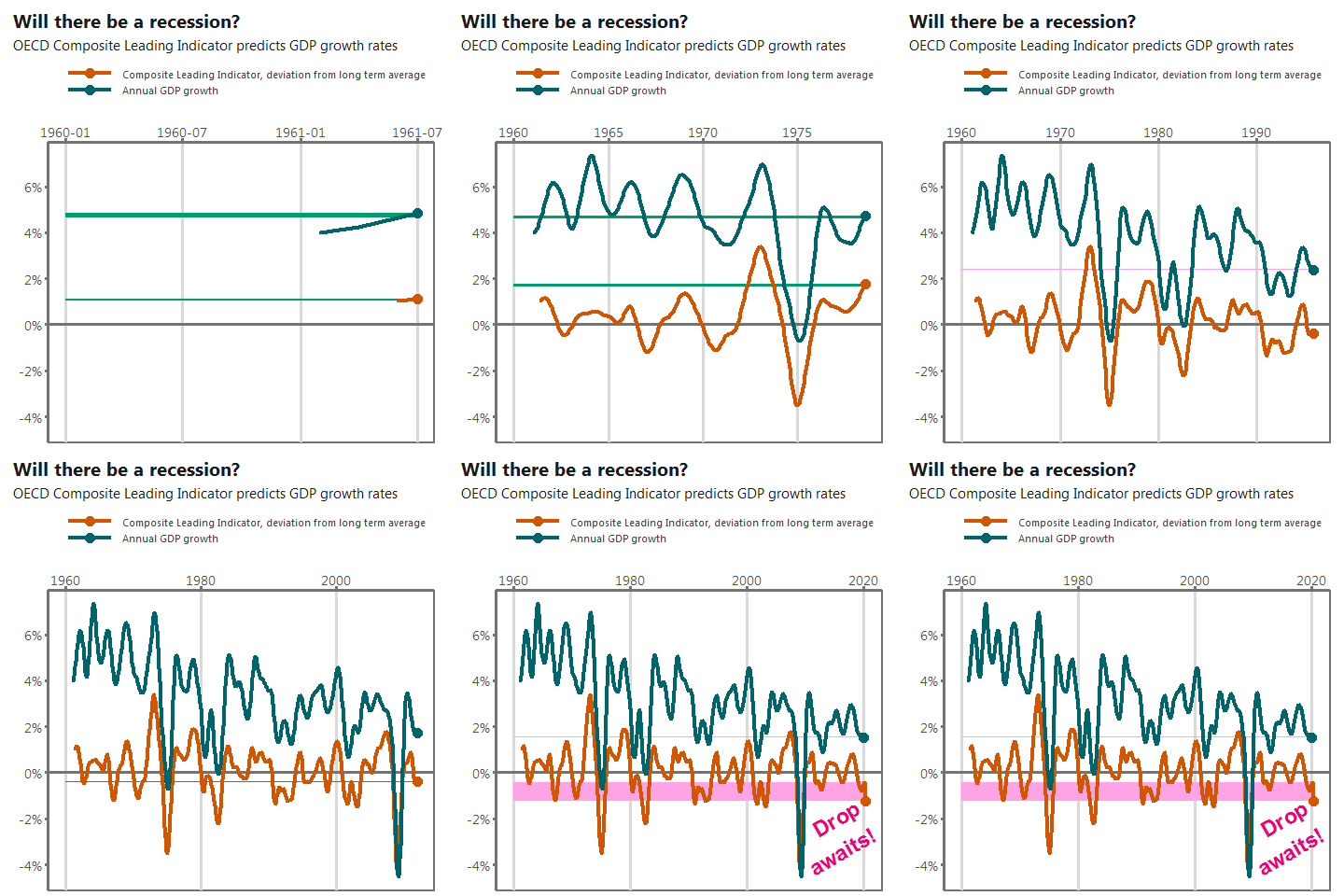
Sure. OECD Composite Leading Indicator (CLI) indicates it. It is surprising how sudden a drop in March 2020 is. Obviously, the only reason for it is the virus.

Will the recession become a crisis of a wider scope? Sadly, CLI does not reach that far into the future.

What: Composite Leading Indicator of OECD countries, amplitude adjusted, percentage deviations from long term average. GDP growth rate of OECD countries comparing month to the same month of the previous year. Both indicators are seasonally adjusted.
When: February 1961 – March 2020.
Where: OECD total, ~40 countries.
Source: OECD

Posted in charts | Tagged Animation, GDP, Line chart, R

Is the EU more homogenous or diverse?

chart planet Posted on 2020-04-15 by Chart Planet2023-03-18
Is the EU more homogenous or diverse?

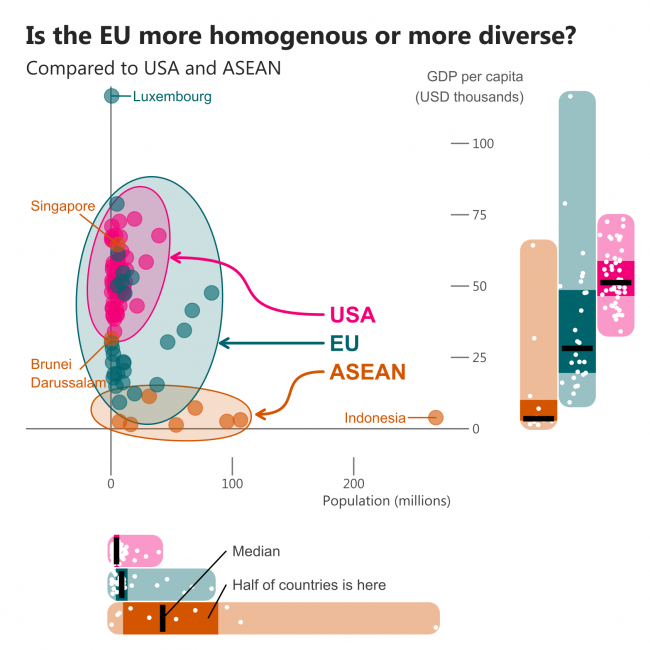
I believe you’ve heard about “Europe of two speeds”. But to understand whether those two speeds are really different we need to compare it to something. I picked two options – one is ASEAN, an organisation in Southeast Asia that promotes integration in economic, political and other fields. Another one is the USA and its states.

I’m comparing two core measures – GDP per capita and population.
Boxplots at the bottom and the right side of the chart show us that the USA is a highly homogenous entity compared to the other two.
If we look at population only, there seems to be a lot of variety in ASEAN, however, there are only 10 countries with one clear outlier – Indonesia. This country is not encircled in the scatterplot, and the encircling ellipses of the EU and ASEAN have quite similar widths. EU just has way more small countries.

Checking the GDP per capita gives a clear view of the diversity of the EU. If the two richest ASEAN countries are excluded, it becomes very homogenous – all the other countries are on the poor side.

Conclusion: EU is diverse even compared to Asian standards.

What: Population and GDP per capita in current USD (for ASEAN and EU) and GDP per capita in chained 2012 USD (for the USA). I believe this inconsistency is of minor influence since the diversity inside the group is what matters – comparisons of states and countries should not be made.
When: 2018, except Population of the USA which is an estimate for 2019
Where: Countries of EU and ASEAN as well as states of the USA.
Source: WB + BEA and USCB for USA states

Posted in charts | Tagged Boxplot, Geopolitics, R, Scatterplot

Do people invest their money?

chart planet Posted on 2020-04-13 by Chart Planet2023-03-18
Do people invest their money?

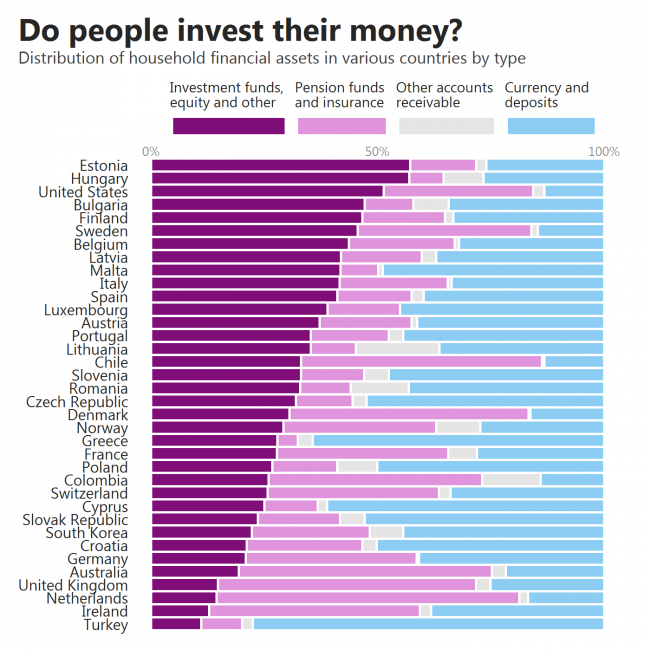
Among my acquaintances, it is not very common to invest in something more sophisticated than pension funds, however, as this chart shows, in some countries more than half of the money in households are held in the form of equity, funds, bonds and other types of investments.
This data does not show how many households invest, just the amounts of money. It is very likely that only a small fraction of the richest people account for the majority of money in the types of investments I focus on.

But let’s celebrate Estonia, Hungary, USA – I believe a lot of people make conscious decisions about money there. Are they good? That’s another question.

What: Distribution of household financial assets by type.
When: 2018
Where: 36 countries form EU or OECD
Source: Data was mixed from two sources, which seem to be very consistent: Eurostat – Household financial statistics + OECD – Household financial assets

Posted in charts | Tagged Investing, R, Stacked bar chart

Does money spent on military means more deaths?

chart planet Posted on 2020-04-08 by Chart Planet2023-03-18
Does money spent on military means more deaths?

After seeing that military spending has no visible relation to deaths in most regions I decided to investigate the special relation the USA has with the wars in the East.

Some major wars in the East are indicated on the chart. During those, the military expenditure of the USA seems to climb up. Data for deaths are available only from 1980, and I filtered out only the relevant region.

Is the USA the reason for those deaths? Or are those people just fighting among themselves, and the USA just gets involved? Does it worsens the situation, or improves? I’ll leave those questions open for now.

What: Military expenditure in constant USD + Deaths due to Conflict and Terrorism.
When: Expenditure: 1949-2018, Deaths: 1980-2017
Where: Expenditure: USA only, Deaths: Middle East, North Africa, and Afghanistan
Source: Institute for Health Metrics and Evaluation for deaths + Stockholm International Peace Research Institute for expenditure.

Posted in charts | Tagged Country specific, Death, Line chart, R

Does money spent on military means more deaths?

chart planet Posted on 2020-04-06 by Chart Planet2023-03-18
Does money spent on military means more deaths?

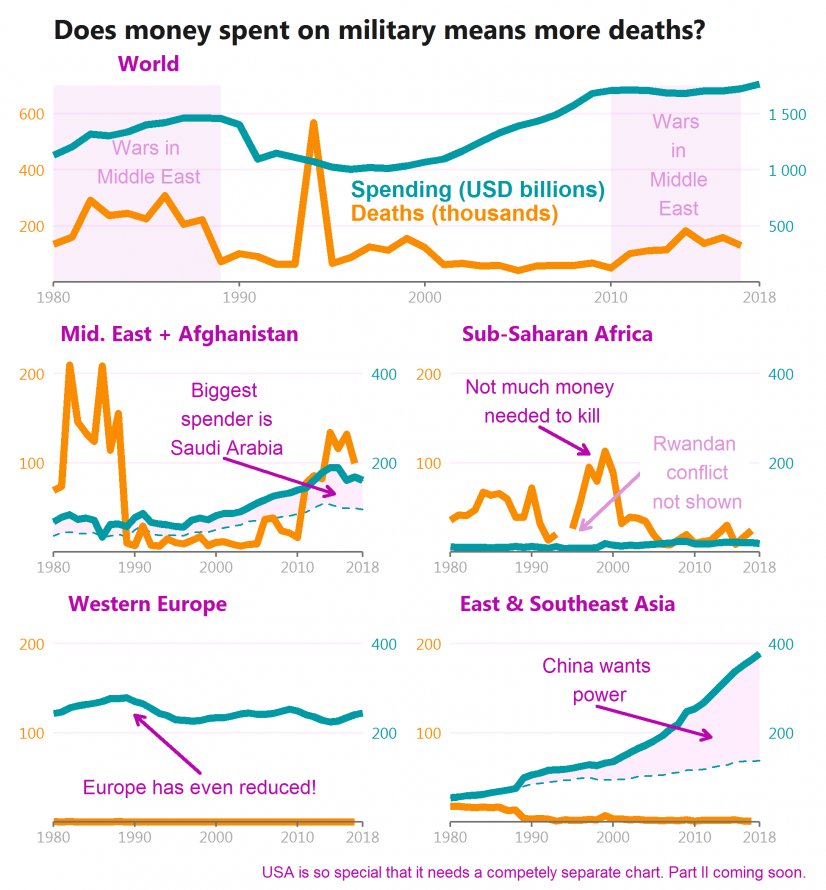
That seems not to be the case. There are many wars in Africa, but not so much money spent. Also, China and countries in Western Europe spend a lot, however, they’re not actively fighting (some missions to some hot spots do not count).

In the Middle East – the boiling point of wars – the biggest spenders are Saudi Arabia, which fights satellite war in Yemen, and Israel which fights against Palestine (as I understand it). But many more casualties come from Iraq, Syria, and Afghanistan, all of which seem to be a mixture of civil wars and satellite wars.

The special case is the USA which will have its separate chart.

This topic is so geopolitical, that I refrain from diving into deeper conclusions, but it’s tempting to say, that more weapons do not make more deaths. More stupidity does.

What:
> Military expenditure in constant USD – some data for USSR and UAE were interpolated using very rough methods – just to fill the gaps and avoid fake jumps. This data have lots of gaps.
> Deaths due to Conflict and Terrorism.
When: 1980-2018 (Data for deaths until 2017)
Where: Probably the whole world
Source: Institute for Health Metrics and Evaluation for deaths + Stockholm International Peace Research Institute for expenditure

Posted in charts | Tagged Death, Line chart, R

Where do people die from epidemics?

chart planet Posted on 2020-03-30 by Chart Planet2023-03-18
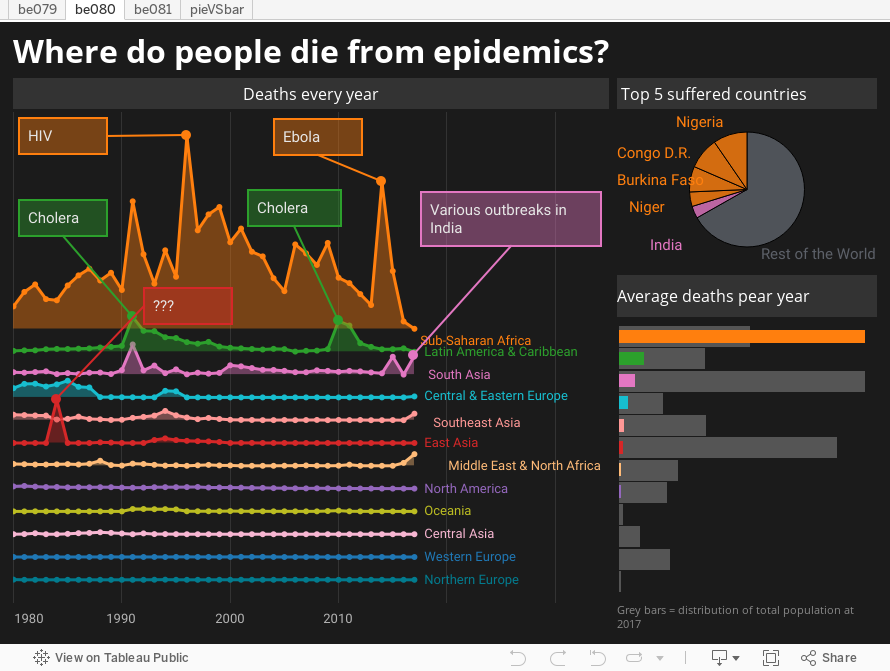
Where do people die from epidemics?

Mostly in Africa. It was quite difficult to find the exact diseases behind particular spikes of deaths, but some of them like Ebola got a lot of attention. Surprising enough, but it seems that in 2017 people suddenly stopped dying from diseases there.

Sadly I could not find what caused so many deaths in China in 1984. Just imagine the results I got when I searched for “china 1994 epidemics” – the overwhelming majority of articles about the current outbreak of coronavirus with some articles claiming that Chinese government is the one from Orwell’s novel.

What: Deaths due to epidemics
When: 1980-2017
Where: 194 countries and regions
Source: Institute for Health Metrics and Evaluation

Posted in charts | Tagged Death, Infographic, Interactive, Tableau

Where do people die from war?

chart planet Posted on 2020-03-25 by Chart Planet2023-03-18
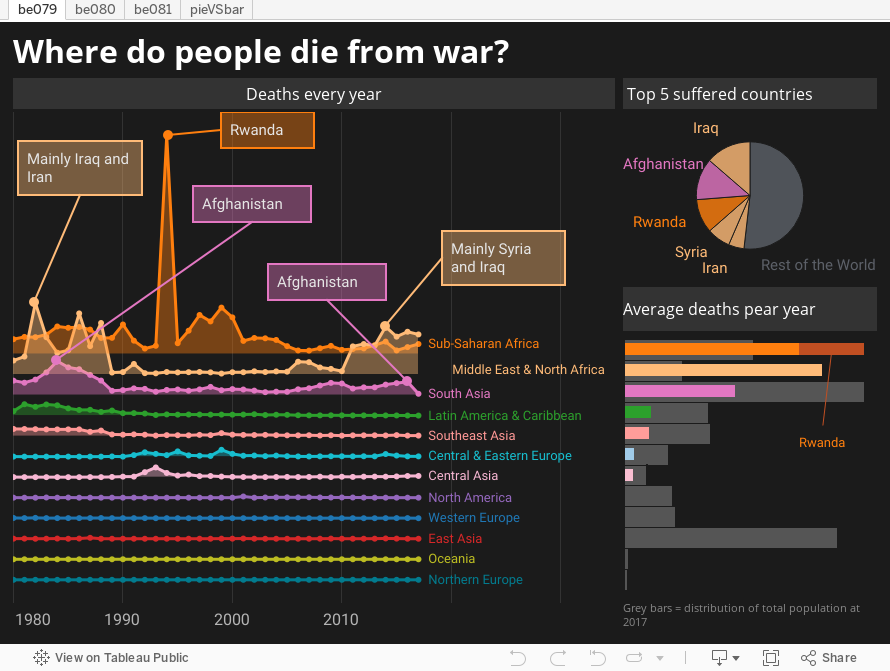
Where do people die from war?

As expected, the most dangerous regions are Africa and the Middle East. However, a single event in Rwanda pushed Sub-Saharan Africa to the first place. Also, half of the deaths from 1980 till 2017 occurred in only five countries (we hear a lot about them in the news).

The rest of the world is more or less peaceful.

What: Deaths due to war and terrorism.
When: 1980-2017
Where: 194 countries and regions
Source: Institute for Health Metrics and Evaluation

Posted in charts | Tagged Death, Infographic, Interactive, Tableau

Why do people die?

chart planet Posted on 2020-03-23 by Chart Planet2023-03-18
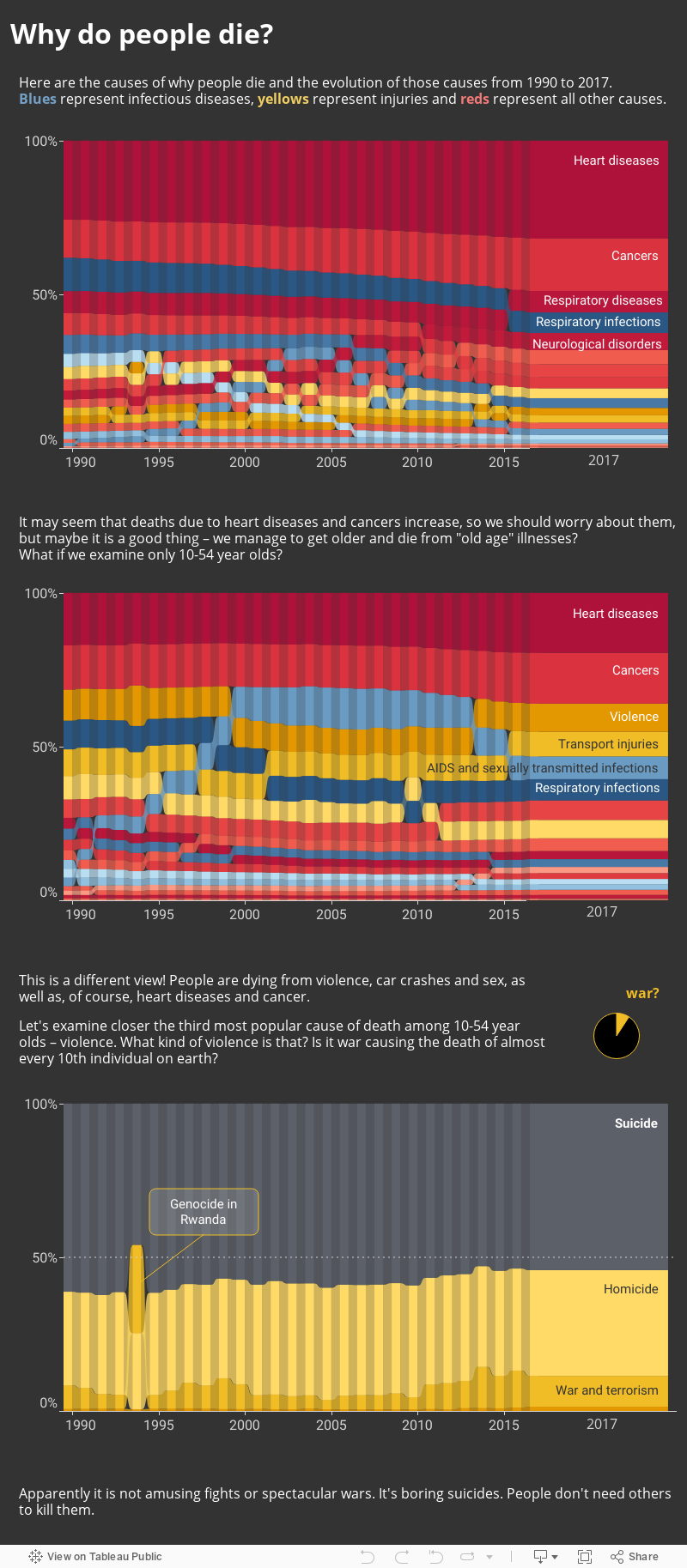
Why do people die?

This is a slightly deeper look into “People die from heart diseases and cancer, so don’t be afraid of terrorism or viruses” idea.

What: Distribution of death by causes.
When: 1990-2017.
Where: Global data which seems to cover most of the world.
Source: Institute for Health Metrics and Evaluation, Global Burden of Disease Study 2017 Results.

Posted in charts | Tagged Data story, Death, Interactive, Tableau

Where do people live the healthiest lives?

chart planet Posted on 2020-03-18 by Chart Planet2023-03-18
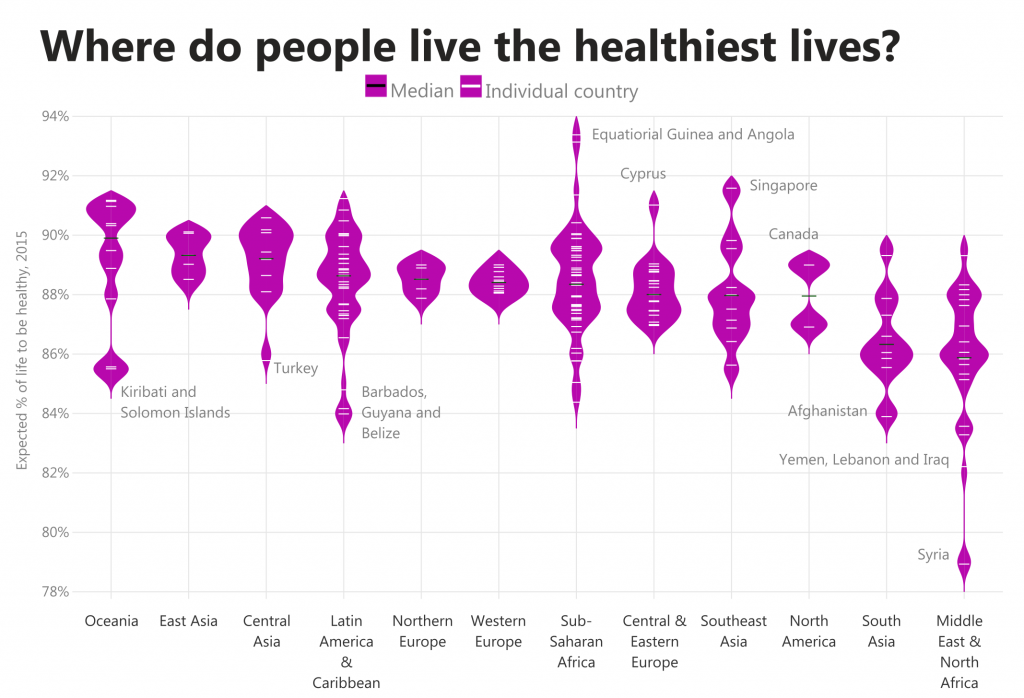
Where do people live the healthiest lives?

I have divided the countries of the world into regions and checked which of them have the highest expected percentage of a healthy life. It’s Oceania followed by East Asia. It would be great to live in Fiji, Tonga or Samoa!

But behold how diverse are the African countries and how homogenous are those from Europe!

What: Healthy life expectancy (HALE) divided by total life expectancy at birth – I’d call it the expected percentage of life to be healthy. Those strange charts show distribution – the wider it is the more values are there. HALE is a form of health expectancy that applies disability weights to health states to compute the equivalent number of years of good health that a newborn can expect.
When: 2015
Where: 183 countries and territories.
Source: FAO

Posted in charts | Tagged Health, Power BI, Violin chart

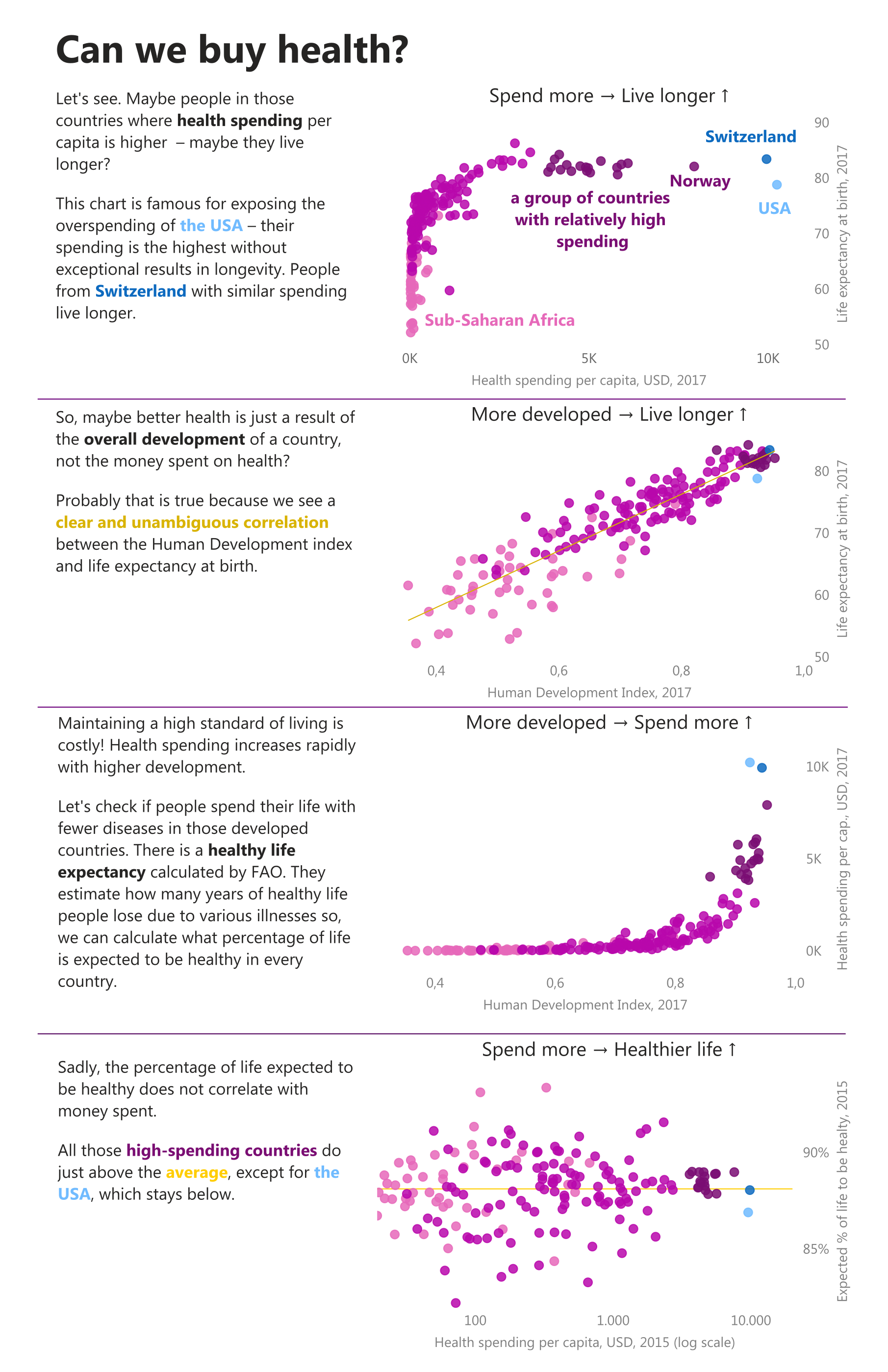
Can we buy health?

chart planet Posted on 2020-03-16 by Chart Planet2023-03-18
Can we buy health?

What: indicated on the charts. Healthy life expectancy (HALE) is used for calculations. HALE is a form of health expectancy that applies disability weights to health states to compute the equivalent number of years of good health that a newborn can expect.
When: all charts are 2017, except the last one which is 2015 because this is the latest data for HALE.
Where: 189 countries and territories of the world.
Source: FAO.

Posted in charts | Tagged Data story, Health, Power BI

Which region feeds the world?

chart planet Posted on 2020-03-09 by Chart Planet2023-03-18
Which region feeds the world?

These are the trade flows between regions of the world measured in dollars. Strange enough – Africa does not provide much food for other regions. I have heard rumours, that Africans starve because they export all the food for rich Europeans! Maybe that’s not true, or maybe there is something specific about the trade flows measured. But according to this data, the Americas feed the world, and Asia is the one being fed.

What: Export of food items, measured in USD. Trade flows inside the region are eliminated.
When: 2017
Where: 243 countries and territories divided into 6 regions, of which Antarctica was not displayed.
Source: FAO

Posted in charts | Tagged Food, Interactive, Sankey, Tableau

Post navigation

<< 1 2 3 4 5 6 7 8 9 >>

subscribe to blog posts

Please check your email to confirm subscription

linkedin fb bluesky instagram tableau sessionize rss
MJDC privacy policy
↑
Cookies are used on chart planet.